
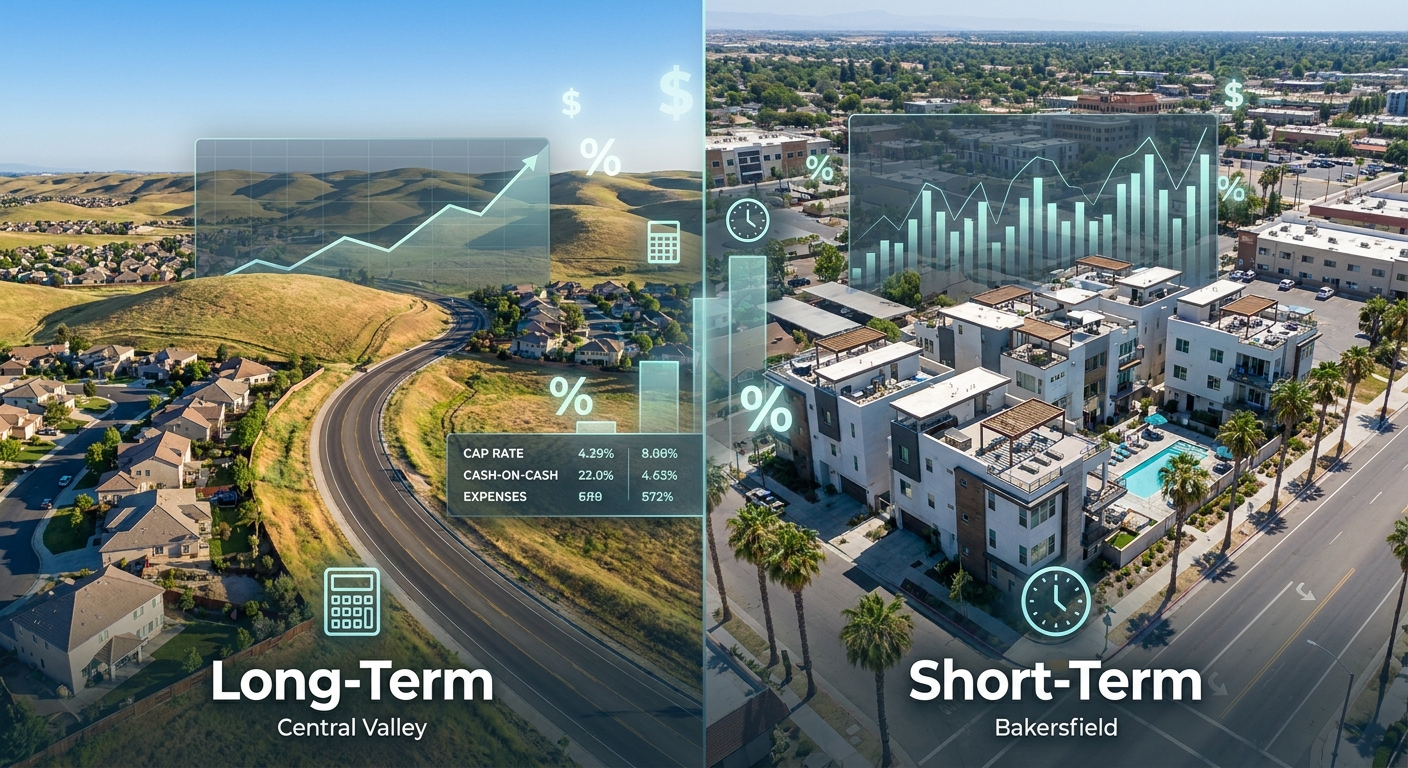
When placing capital in Central Valley residential real estate, investors look to Bakersfield and Kern County for yield profiles that coastal California markets cannot match. Lower entry prices relative to state averages create opportunities for both long-term rental (LTR) buy-and-hold strategies and short-term or mid-term rental (STR/MTR) executions.
Evaluating where to deploy capital requires looking past gross rental estimates and underwriting net operating income (NOI), cap rates, and real-world expense ratios accurately.
Underwriting Long-Term Rentals in Kern County
Long-term residential leases remain the foundation for capital preservation and predictable cash flow across Bakersfield, Oildale, Shafter, and Delano.
Consider a representative single-family acquisition in Bakersfield at a purchase price of $340,000.
* Gross Monthly Rent: $2,200 ($26,400 annually) * Gross Yield: 7.76%
Operating expenses for an LTR in Kern County typically run between 35% and 40% of gross revenue when properly reserve-funded:
* Property Tax (Kern County ~1.15% - 1.25% effective rate): $4,080/year * Hazard Insurance: $1,200/year * Property Management (8% - 10%): $2,376/year * Maintenance & Capital Expenditure Reserve (10%): $2,640/year * Vacancy Reserve (5%): $1,320/year
Total annual operating expenses equal approximately $11,616. This yields an estimated Net Operating Income (NOI) of $14,784, translating to an unlevered Cap Rate of roughly 4.35% on turnkey assets. Value-add acquisitions in submarkets like Oildale or east Bakersfield can push unlevered cap rates to 5.5% – 6.2%.
Assuming an investment loan with 25% down ($85,000) at a 6.75% interest rate on a 30-year amortization schedule, annual debt service equals approximately $19,850. At these interest rate levels, levered cash-on-cash returns require careful entry pricing or targeted value-add execution to achieve net levered yields above 5%.
Underwriting Short-Term and Mid-Term Rentals
Short-term rentals (nightly stays) and mid-term rentals (30+ day stays for traveling professionals) offer higher potential gross revenue, driven by Kern Medical, Mercy Hospitals, Adventist Health, energy sector contractors, and agricultural operations.
Taking the same $340,000 asset in Bakersfield or Tehachapi:
* Average Daily Rate (ADR): $130/night * Occupancy Rate: 65% (approx. 20 occupied nights/month) * Gross Monthly Revenue: $2,600 ($31,200 annually) * Mid-Term Rental (MTR) Range: $2,800 – $3,300 gross monthly for fully furnished 30-day+ stays.
Operating expense structures for STRs and MTRs are considerably higher than LTRs, running between 48% and 55% of gross revenue:
* Utilities (Electric, Gas, Water, Internet): $3,600/year (Central Valley summer cooling costs add substantial expense) * Turnover & Cleaning Fees (Net of guest reimbursements): $1,800/year * Furnishings Amortization & Supplies Reserve: $1,500/year * Management & Channel Booking Fees (15% - 20%): $4,680/year * Taxes, Insurance, & Maintenance: $6,500/year
Total operating expenses average roughly $18,080, leaving an NOI of approximately $13,120 to $16,500 depending on seasonality. Unlevered Cap Rates land between 4.8% and 5.8%.
Expense Friction and Execution Differences
When evaluating these strategies side-by-side, several operational realities impact net margins:
1. Utility Overhead: In a long-term rental, tenants pay PG&E directly. In an STR/MTR, the property owner absorbs utility costs. Central Valley summer temperatures routinely exceed 100°F, driving up cooling bills that directly erode NOI if not factored into the budget.
2. Regulatory & Tax Compliance: The City of Bakersfield enforces Transient Occupancy Tax (TOT) for stays under 30 days. Switching to a mid-term rental strategy (30+ days) eliminates TOT liability while maintaining higher gross rent profiles than standard long-term leases.
3. Vacancy Volatility: Long-term residential tenant retention in Kern County provides steady year-round income. Short-term occupancy varies seasonally, requiring higher cash reserves to cover debt service during slower winter months.
Underwriting the Optimal Strategy
At Central Valley REI, led by Brandon Hardin and Gary Frausto, we analyze properties based on strict risk-adjusted yield requirements.
Investors seeking low operational overhead and consistent debt paydown often prefer long-term leases in Bakersfield, Delano, or Shafter. Investors equipped to handle furnishing capital, utility costs, and dynamic pricing often find the mid-term rental model—targeting traveling nurses and corporate contract workers—delivers the optimal balance between cash flow expansion and regulatory compliance.